

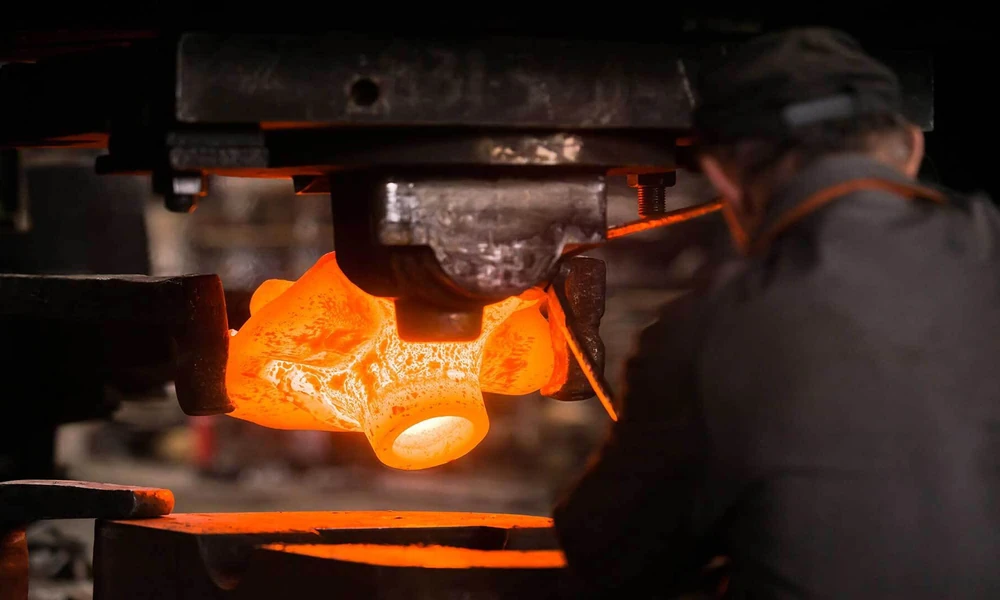
A village blacksmith and a modern forging press share one basic idea: heat the metal until it softens, then force it into shape while it is solid. The press simply does it with far more force, closed steel dies and enough repeatability to make the ten-thousandth part match the first. Brass forging companies use that idea to turn short lengths of bar into valve bodies, plumbing fittings and gas connectors, while steel forging shops use it for hand tools, axle spindles and lifting hardware. An experienced metal forging manufacturer selects the right combination of material, temperature and die design to produce components suited to their intended applications.
For a buyer, the interesting question is less about how dramatic the process looks and more about when it beats pouring the same part as a casting. The answer depends on the alloy, the shape, the volume and what the part has to survive in service. Getting it right early avoids paying for dies that suit the wrong process.
What Actually Happens to Metal During Hot Forging?
Hot forging is done above the temperature at which the metal recrystallizes. At that heat the grains can deform and then re-form as new, finer grains, so the metal flows without cracking and does not harden much as it is squeezed. Small internal voids left over from the original ingot or bar are pressed closed in the process.
The other effect is grain flow. As the metal fills the die, its internal structure stretches and bends to follow the outline of the part, a little like the grain in a piece of wood following the curve of a branch. A forged wrench jaw or hook has grain running around its corners, which helps it resist fatigue and impact at exactly the spots where loads concentrate.
From Billet to Trimmed Part: What Are the Steps in Closed-Die Forging?
Most production forging uses closed dies, two blocks of tool steel with the part shape machined into them. The sequence is fairly consistent across shops. Bar stock is sawn or sheared into billets of a set weight, and each billet is heated in an induction coil or gas furnace. It then goes into the die, where a press or hammer forces it into the cavity, sometimes through one or two shaping stages first.
The die is designed so a little surplus metal escapes between the halves, forming a thin rim called flash. That rim is what makes the cavity fill completely, and a trim press shears it off afterward. Parts are then cooled, shot blasted to remove scale, heat treated where the alloy calls for it and passed to machining for threads, bores and sealing faces.
Why Do Brass Forging Companies Work at Lower Temperatures than Steel Shops?
Common forging brass, often specified as alloy C37700, is roughly 60 percent copper with zinc making up most of the balance and a small amount of lead to help machining. It is typically hot forged somewhere between about 1,200°F and 1,500°F. Carbon and alloy steels, by contrast, are usually heated above 2,000°F before they go into the die.
That gap changes the whole operation. Hot brass flows readily, so it fills sharp detail and thin sections with modest press force, and the dies run cooler and last longer. A brass forging manufacturer can therefore produce near-net shapes such as tee fittings and valve bodies that need only light machining. In the United States, parts that touch drinking water must meet federal low-lead limits, so those fittings are forged from low-lead brasses in place of leaded C37700, and the alloy is settled before any die work begins. Copper alloy die forgings are commonly bought to ASTM B283, which lists the alloys and properties for hot-pressed parts.
Where Does Steel Forging Earn Its Place?
Steel parts that take repeated shocks or cyclic loads are the classic forging work. Track links, pipeline fittings, gear blanks, lifting eyes and many automotive suspension parts are forged because a dense, flowing grain structure holds up well under fatigue. Forged steel parts are usually heat treated afterward, by normalizing or by quench and tempering, to reach the hardness and toughness the drawing specifies.
A steel forging manufacturer faces harder conditions than a brass shop. Higher temperatures mean more scale on the part, faster die wear and heavier presses. Close tolerance features are typically machined after forging, and the forging is designed with enough stock on those faces to clean up.
Forging or Casting: How Do Shape, Size and Volume Tip the Decision?
Forging suits solid or moderately hollow shapes that can be pressed out of a die from two directions. It struggles with enclosed internal cavities, complex cored passages and very large parts, because die cost and press capacity climb steeply with size. A casting manufacturer, on the other hand, can form complex internal shapes with sand cores and handle sizes that would need an enormous press.
Volume matters as well. Forging dies are a real investment, so forging tends to pay off over steady, repeating orders. Casting patterns for sand work cost less, which makes casting attractive for low quantities and designs that may still change. Pressure tightness often settles the matter for brass plumbing parts, since a forged body has very little internal porosity to create a leak path. Material can decide it too, since gray iron is too brittle to forge at all.
Is It Possible to Switch a Cast Part to Forging Later?
Yes, and buyers sometimes make the switch when volumes grow or when a cast part shows leaks or fatigue cracks in service. The conversion is a redesign, though. Forging needs draft on the die walls, generous radii, a sensible flash line and internal passages that can be drilled after forging since they cannot be cored. Brass forging companies and steel shops will usually ask for the casting drawing, the annual quantity and the service conditions before suggesting how the geometry should change.
Does Forging Always Produce a Stronger Part?
Not always, because the gain from forging depends on the alloy, the direction of loading and the heat treatment that follows. A forging is usually tougher and more fatigue resistant in the direction its grain runs, while a well-made casting of a grade designed for casting can meet the strength needs of many valve bodies, housings and brackets. A casting manufacturer can also produce complex geometries that may be difficult or uneconomical to achieve through forging. The sensible comparison is between the properties each route delivers for the specific part and the cost of reaching them. Matching the process to the shape, size, volume and service load gives a better result than assuming one method wins every time.
